Middle Eastern companies’ climate disclosure is rising, but S&P Global analysts expect more emissions reduction commitments

A report published by S&P Global Sustainable1 following COP28 in December 2023 analyzed the greenhouse gas (GHG) emissions and climate disclosure rates of companies headquartered in the Middle East and found that, based on the S&P Global Trucost Environmental dataset, companies in the region have increased their GHG disclosure rates during the past five years. Still, more work is needed since the region's emissions have continued to climb.
Out of a universe of 632 companies headquartered in the Middle East for 2021 (the most recent year data is available), around 25% disclose Scope 1 and Scope 2 GHG emissions, a rate that is approximately 20% lower than disclosure levels for the rest of the world.
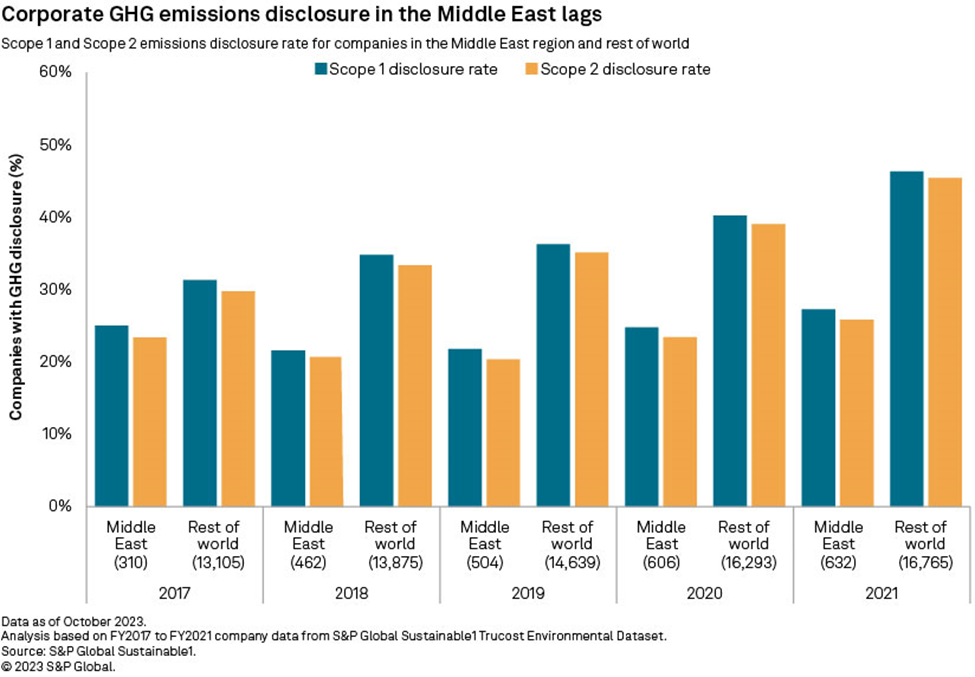
However, the S&P Global Sustainable 1 analysis showed that companies headquartered in Turkey and the UAE have higher disclosure rates on Scope 1 and Scope 2 emissions than the averages for the rest of the world. The average Scope 1 disclosure rate for the UAE is 53% and 56% for Scope 2, compared to averages of 46% and 45%, respectively, for the rest of the world. Among the universe of UAE-headquartered companies in the analysis, S&P Sustainable1 found that disclosure levels are 20% higher than in the rest of the Middle East.
Alongside improvements in disclosure, emissions are still rising
While disclosure rates are improving in the Middle East, the region has significant work to do to lower emissions. GHG emissions totaled 1.1 billion metric tons for the 632 Middle East-headquartered companies in our analysis* for 2021, the most recent year available. Five years earlier, that number was 370 million tons — a difference partly explained by the smaller analysis universe of 310 companies in 2017. It also demonstrates that companies may have to accelerate their transition pathways to reduce their emissions as their countries transform to become less dependent on fossil fuels.
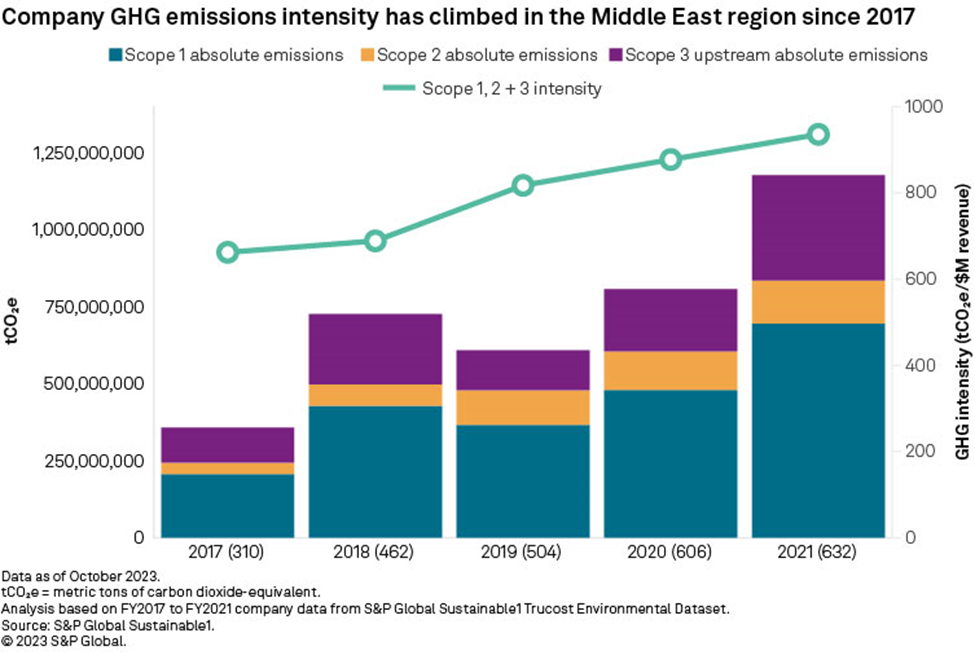
Like many parts of the world, the region is also experiencing increasing climate stress, as the physical impacts of climate change manifest in rising temperatures, droughts, and floods. As they transition their economies to depend less on fossil fuels, many Middle Eastern countries will take steps to address higher energy demand from their growing populations to cope with an ever-hotter desert climate that needs more power generation, especially in energy-intensive industries such as water desalination.
*(The numbers in this analysis only represent the emissions of companies in the S&P Global Sustainable1 Trucost Environmental dataset and do not represent total emissions for all companies located in the Middle East.). This report was originally published as part of a joint publication by S&P Global Sustainable1 and the Dubai Financial Market, a stock exchange in Dubai, United Arab Emirates, where the UN’s COP28 climate change occurred. You can read the full report, including a Foreword from Dubai Financial Market CEO Hamed Ali, here.