SPGCI Solar Module PV assessments bring pricing transparency to a volatile market
S&P Global Commodity Insights has launched its Platts Solar Module PV price assessments to aid market participants in managing their trade of solar PV components in what has become a very liquid and volatile market, according to S&P Global Commodity Insights research. The first Platts Solar PV Module price assessments were delivered to the market July 1.
The Platts Solar Module PV price offering includes assessments on tunnel oxide passivated contact (TOPCon) solar modules. "But it will adapt to emerging technologies as they become more mainstream," said Annalisa Jeffries, global head, Electricity Power Pricing at S&P Global Commodity Insights. "We do track the price spreads and outright prices of other PV technologies versus TOPCon."
Geared toward the needs of suppliers, utilities, and project developers, it will offer daily price assessments reflecting the value of solar modules procured for both commercial and industrial and utility-scale projects across six categories:
Platts will publish the six individual solar module prices alongside the Platts Global Solar Module Marker, a daily average of the six individual assessments, to provide a global perspective of solar panel prices. The price assessments will cover solar modules with 570 Watt (W) to 720 W of output and TOPCon specification and wafer sizes of 182 millimeters (mm) to 210 mm. Prices will be expressed as an outright price in US$/W.
"We have a structural overcapacity globally in solar PV components, which is not a surprise for a technology that is supply driven," said Eduard Sala de Vedruna, Vice President, Clean Energy Technology, S&P Global Commodity Insights. "This market is extremely volume driven and suffers from systemic oversupply and price volatility. We see significant fluctuation in prices, which reduces the transparency of the market. Since buyers must purchase their equipment in relatively short timeframes, they need price transparency to optimize their procurement strategies."
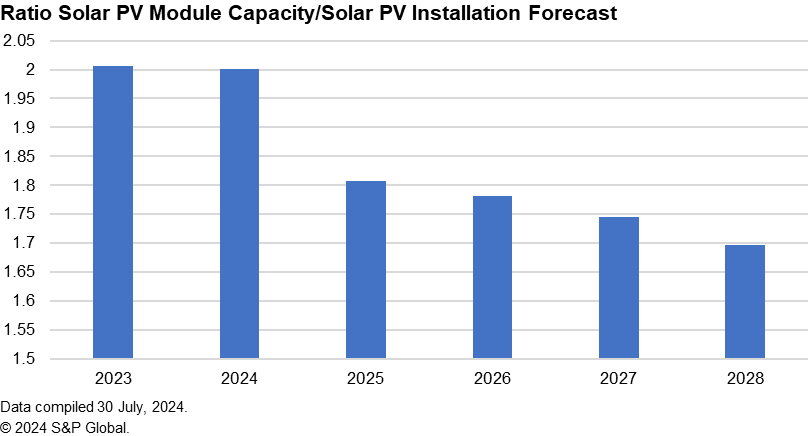
According to S&P Global Commodity Insights Clean Energy Technology researchers, the solar PV module market currently has a manufacturing capacity over 1 TWdc that almost duplicates the forecasted installations in 2024. As demand increases and rationalization occurs throughout the supply chain, the ratio-module capacity/installations is expected to decline but still outweigh installations until 2028.
The solar PV market has multiple manufacturers who are trying to optimize their manufacturing capacity and minimize costs, since the more they produce the cheaper the unit price becomes. Most manufacturing for solar components occurs in China and is shipped globally, but much of the solar panels are shipped from China to Europe and the US, Sala de Vedruna said.
"Our S&P Global Commodity Insights Platts Solar Module PV price assessments look at the equipment as one part of the total cost of solar equipment," Sala de Vedruna said. "Most solar equipment is interchangeable, and the quality is consistent, so the differences are minor, which means the equipment is becoming commoditized."
Due to this commoditization of solar PV components, Sala de Vedruna said production can be ramped up or down very rapidly, which has created volatility and the need for market transparency that the new S&P Global Commodity insights Platts Solar PV Module price assessments deliver. When the market is flooded with components, the spot market requires a benchmark price to enable trade, he said.
In-depth market analysis and transparent pricing enables customers to act with confidence
With the addition of the Platts Solar PV Module price assessments, S&P Global Commodity Insights provide more than just pricing. The company delivers the power of its market pricing expertise but also combines that with the added deep market insight of solar power supply and demand trends and outlooks, a combination only offered by S&P Global Commodity insights.
"The power of this combination of both transparent market pricing and in-depth solar market insight enables our customers to make more informed decisions based on both short- and long-term solar power market outlooks, but also current and historical pricing and ‘heards’ for solar PV components, which is extremely valuable to them," Jeffries said. "Our customers and others in the market have asked for this Platts Solar PV Module price assessment offering, and with its launch, they now have the power to progress their transactions with greater confidence."
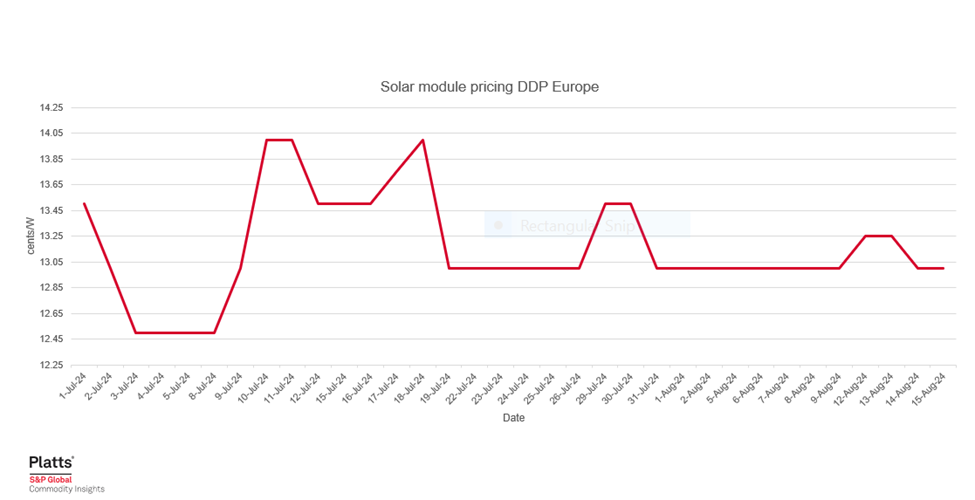
According to S&P Global Commodity Insights, Platts PV solar module prices have been volatile, but are now relatively stable and remain low (through mid-August 2024).
The balance of solar PV supply and demand impacts the market and pricing, Sala de Vedruna said that, if you can predict the trajectory of the market, you can have framework agreements based on that direction. However, the extreme volatility of the market makes it difficult for buyers and sellers to feel comfortable signing contracts.
"The S&P Global Commodity Insights Platts Solar PV Module price assessments provide market participants an invaluable reference point by creating a pricing standard, giving them a sense of what to expect," Sala de Vedruna said. "They can define the price at any moment and determine what they will accept. It creates visibility that is essential to pricing transparency and market progress."
For more information on the S&P Global Commodity Insights Platts Solar PV Module price assessments, please visit:
Platts Solar Module Price Assessments FAQ | S&P Global Commodity Insights (spglobal.com)
Access the Platts Solar Module Derived Price Assessments here.